THE THIRD VISUAL REGIME
Solo Exhibition, CAS, OSAKA, 2026
The Third Visual Regime Series 1 CAS 2026

This exhibition presented The Third Visual Regime as a spatial argument rather than a sequence of paintings. Paintings, wall texts, and architectural relationships functioned together to examine how different visual systems operate simultaneously.
Exhibition Structure
WALL 1. Condition of Vision
WALL 2. Shift of the Problem
WALL 3. Collision
WALL 4. Operation
WALL 5. Destabilization
WALL 6. Third Visual Regime

Exhibition Views &Wall Text
WALL 1. Condition of Vision

This study does not critique modernity at the level of representation. It examines the conditions of vision that have made modernity possible. Visual culture studies have shown that perspective and vision are historically and institutionally constructed, yet these approaches remain primarily analytical and do not propose methods for transforming visual systems. Perspective is not merely a technique of depiction but a system that organizes vision by producing a single point of view and a fixed subject position. This exhibition treats this system not as an object of description but as an operational condition.
WALL 2. Shift of the Problem

Conventional visual studies have focused on analyzing representation and meaning, while leaving the underlying conditions of vision intact. This study shifts the problem from representation to the conditions that make seeing possible. The question is not what is seen, but under what conditions seeing can occur. This study treats these conditions not as objects of analysis but as objects of operation.
WALL 3. Collision

This study constructs a structure in which multiple visual regimes operate simultaneously within a single image without coherence. Contour (a logic of relation) and volume (a logic of control) are based on different visual principles: one resists perspective, while the other reinforces it. These systems are incompatible, yet they are forced to coexist within the same image. The aim is not synthesis but collision, through which the coherence of vision itself becomes the object of manipulation.
WALL 4. Operation

The structure is repeated under varying conditions to examine the operation of visual systems. Non-perspectival vision and perspectival vision, including chiaroscuro, are made to compete at the level of viewpoint, scale, light, and composition. The differences that emerge are not stylistic but function as controlled variables. Local coherence and global incoherence are produced simultaneously as conditions for examining the structure of vision.
WALL 5. Destabilization

The simultaneous operation of multiple visual regimes prevents the formation of a single stable point of view. While local areas remain readable within a perspectival logic, the overall structure collapses, forcing the viewer to shift between multiple viewpoints. The point of view becomes dynamic rather than fixed, and perception is maintained in a continuous state of tension.
WALL 6. Third Visual Regime

This study defines the condition in which multiple visual systems collide and none can restore neutrality or dominance as the “Third Visual Regime.” This is not a new style but a structural condition in which stabilization is prevented. Vision is thereby redefined not as a natural or universal faculty, but as historically constructed, institutionally conditioned, and subject to manipulation.
Artist Talk with Yasuhiko Okumura
(Director of the Museum of Ceramic Art, Hyogo)
July 11.2026
Catalog (Text ,Yasuhiko Okumura)

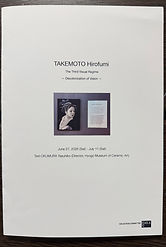

Pulishing,CAS
This exhibition constitutes the first iteration of an ongoing exhibition format. Future versions will continue to evolve through new venues, new spatial conditions, and dialogue with different institutional contexts.